


 Guide
 March 1, 2026
TikTok marketing has evolved dramatically in 2026. AI-driven personalization increases user engagement time by more than 35%, fundamentally changing how brands connect with audiences. Despite common assumptions, users aged 30-45 make up 40% of TikTok’s active user base, while interactive features and commerce tools transform campaigns into direct revenue channels. This guide explores how marketers can leverage these shifts to maximize ROI and build authentic audience relationships.
Table of Contents
- Introduction To TikTok Marketing Trends 2026
- AI And Content Personalization
- Interactive Formats And Engagement
- Commerce Integration On TikTok
- Data And Analytics Optimization
- Common Misconceptions In TikTok Marketing
- Content Strategy And Trend Utilization
- Team Collaboration And Workflow Optimization
- Algorithmic Changes And Implications
- Conclusion And Practical Takeaways
- Boost Your TikTok Marketing With Advanced Analytics Tools
Key Takeaways
| Point | Details |
|---|---|
| AI Personalization Impact | AI content personalization boosts engagement by 35% through tailored For You page delivery. |
| Interactive Format Advantage | Interactive features increase branded video engagement by 27% compared to static content. |
| Commerce Integration Growth | Live shopping and seamless checkout enable direct sales conversions on platform. |
| Metric Priority Shift | Engagement rates predict sales 2.5x better than follower counts for campaign success. |
| Algorithm Evolution | 2026 updates favor diverse content formats while reducing repetitive promotional reach by 20%. |
Introduction to TikTok Marketing Trends 2026
TikTok’s platform reached over 1 billion active users worldwide in 2026, cementing its position as a critical marketing channel. The demographic landscape has shifted significantly, with users aged 30-45 comprising 40% of the active user base, demolishing outdated perceptions about platform maturity. This expansion has unlocked billions in commerce transactions through integrated shopping tools.
Three major forces drive marketing evolution on TikTok in 2026. First, artificial intelligence powers unprecedented content personalization, matching user preferences with remarkable accuracy. Second, interactive formats including polls, quizzes, and augmented reality effects transform passive viewers into active participants. Third, commerce integration eliminates friction between discovery and purchase, turning entertainment into immediate transactions.
Understanding these trend drivers is essential for marketers competing in an increasingly sophisticated ecosystem. Brands that master AI optimization, interactive engagement, and seamless commerce integration capture disproportionate attention and revenue. The following sections dissect each trend with actionable strategies backed by current data.
Key platform developments shaping 2026 marketing strategies include:
- Advanced AI recommendation systems learning individual preferences across millions of data points
- Native commerce tools supporting live shopping events and product catalog integration
- Enhanced analytics dashboards providing real-time campaign performance insights
- Algorithm updates prioritizing content diversity and meaningful user interactions
AI and Content Personalization
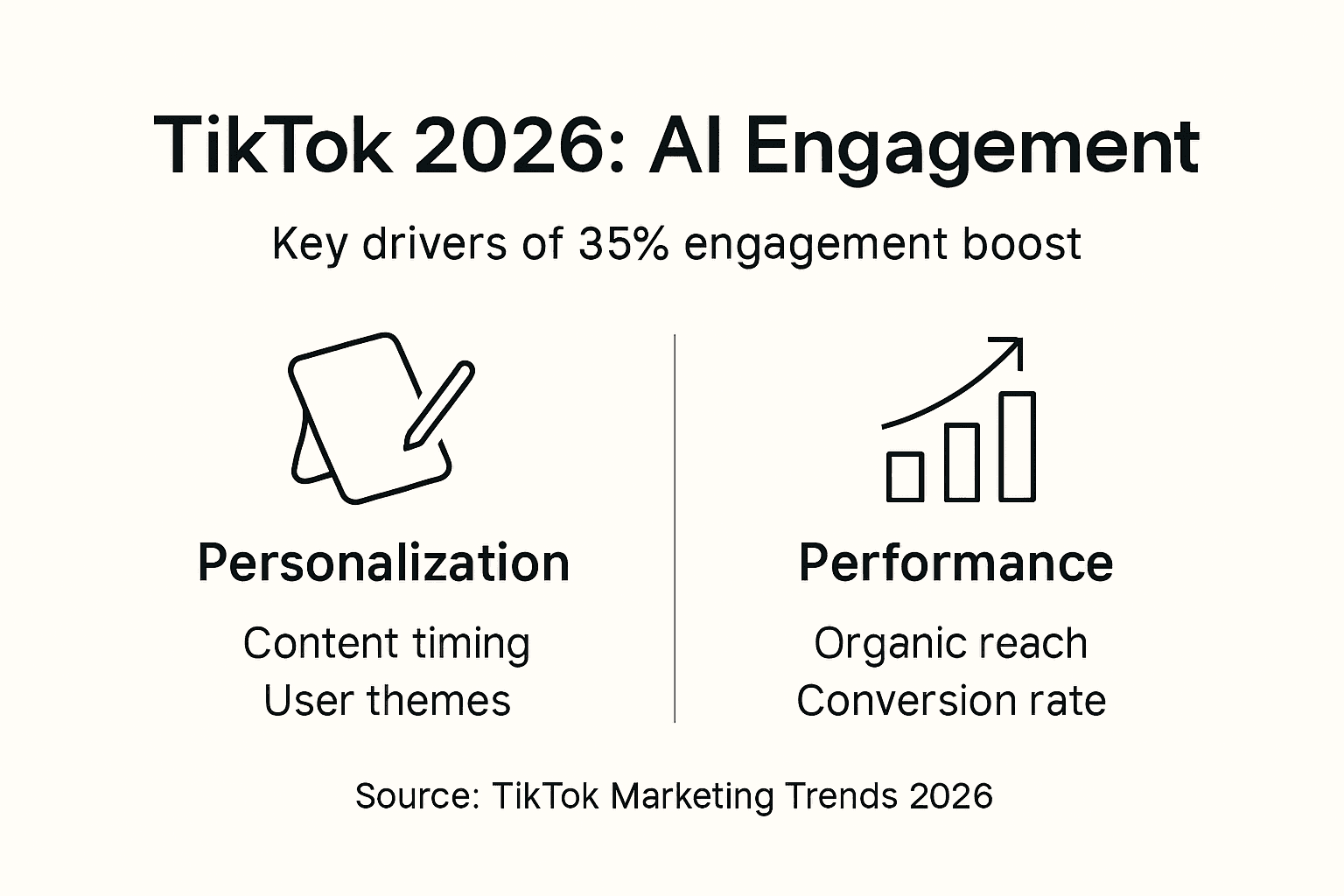
TikTok’s recommendation engine has become remarkably sophisticated in 2026. The algorithm analyzes viewing patterns, completion rates, interaction history, and contextual signals to curate each user’s For You page with precision. This AI-driven personalization increases engagement time by more than 35%, as users encounter content aligned with their specific interests and consumption habits.

Successful brands leverage personalization data to optimize content timing, themes, and messaging. Rather than broadcasting generic promotional messages, marketers create niche content variations targeting specific audience segments. A beauty brand might produce separate video series for skincare enthusiasts, makeup artists, and eco-conscious consumers, allowing the algorithm to match each piece with receptive viewers.
The practical application extends beyond content creation into strategic planning. Marketers analyze which content themes drive highest completion rates among target demographics, then double down on those approaches. For example, tutorials consistently outperform product showcases for certain age groups, while behind-the-scenes content resonates with brand-conscious millennials.
Personalization strategies that maximize AI advantage:
- Test multiple content angles within the first 48 hours to gather engagement signals quickly
- Create topic clusters allowing the algorithm to identify your niche expertise
- Optimize video hooks for the first three seconds when AI assesses viewer retention probability
- Schedule posts during peak activity windows for your specific audience segments
Pro Tip: Use TikTok’s analytics to identify your top-performing content themes, then create variations exploring adjacent topics. The algorithm rewards consistent topical authority while discovering new audience segments interested in related subjects.
Brands implementing AI personalization strategies report significant improvements in organic reach and conversion rates. The key lies in feeding the algorithm diverse signals while maintaining thematic coherence that establishes your content authority within specific niches.
Interactive Formats and Engagement
TikTok introduced powerful interactive features in 2026 that transform passive content consumption into active participation. Polls, quizzes, augmented reality lenses, and interactive stickers enable viewers to influence content outcomes, express preferences, and engage beyond simple likes or comments. Research shows interactive features boost branded video engagement by 27% compared to traditional video formats.
Brands harness these tools creatively across campaign objectives. Product launches incorporate polls asking audiences to vote on color options or feature preferences, generating buzz while gathering market research. Contests use AR filters encouraging user-generated content submissions, exponentially expanding campaign reach through participant networks. Live shopping events integrate real-time Q&A and instant polls, maintaining viewer attention throughout extended broadcasts.
The algorithmic benefit of interactivity extends beyond immediate engagement metrics. When users actively participate through polls or filter usage, TikTok interprets this as strong interest signals, increasing the likelihood of showing future content from that creator or brand. This creates a virtuous cycle where interactive content receives preferential distribution, driving higher sustained visibility.
Effective interactive content applications include:
- Product development polls gathering customer input on upcoming releases
- Quiz-based educational content teaching industry concepts while qualifying leads
- AR try-on experiences reducing purchase hesitation for fashion and beauty products
- Challenge campaigns using branded effects to encourage user participation and content creation
“Interactive features have fundamentally changed how we approach TikTok campaigns. The engagement depth we achieve through polls and AR effects creates stronger brand relationships than any traditional ad format.” – Leading social media marketing director
Marketers implementing interactive content tactics report higher comment quality, increased shares, and improved conversion rates. The format naturally encourages viewers to slow down and engage thoughtfully rather than scrolling past, creating memorable brand moments that translate to bottom-line results.
Commerce Integration on TikTok
TikTok’s commerce infrastructure matured significantly in 2026, enabling frictionless shopping experiences directly within the app. Live shopping events have transformed direct-to-consumer sales, with leading brands reporting conversion rate increases up to 30% compared to traditional e-commerce channels. Seamless checkout eliminates the friction of redirecting users to external websites, capitalizing on impulse purchase behavior.
The platform’s product catalog integration allows brands to tag items within regular content videos, not just dedicated shopping broadcasts. Viewers tap tagged products to view details, pricing, and purchase options without leaving TikTok. This ambient commerce approach transforms entertainment content into sales opportunities, blurring the line between discovery and transaction.
Successful commerce strategies combine trending content formats with strategic product placement. A fashion brand might create a “get ready with me” video featuring tagged outfit items, or a home goods company could showcase room transformations with linked products. The key lies in maintaining authentic content value while making purchasing effortless for interested viewers.
| Commerce Feature | Adoption Rate | Average Sales Impact |
|---|---|---|
| Live Shopping Events | 68% of brands | +30% conversion rate |
| In-Video Product Tags | 52% of brands | +22% click-through |
| TikTok Shop Storefronts | 41% of brands | +18% order value |
| Affiliate Creator Partnerships | 73% of brands | +35% reach expansion |
Pro Tip: Combine commerce features with influencer partnerships for maximum impact. Creators with established audience trust drive significantly higher conversion rates than brand-direct promotional content, especially when they authentically use and recommend products.
Marketers adopting commerce integration strategies benefit from direct ROI tracking unavailable in traditional awareness campaigns. TikTok’s analytics connect specific videos to purchase behavior, enabling precise optimization of content approach, posting schedule, and promotional messaging based on actual sales data.
Data and Analytics Optimization
TikTok’s business analytics tools evolved substantially in 2026, providing marketers with sophisticated real-time performance tracking. The platform now offers granular insights into engagement patterns, audience demographics, traffic sources, and conversion funnels. This data empowers rapid strategic pivots, allowing marketers to amplify successful approaches while quickly abandoning underperforming tactics.
The shift toward data-driven optimization has proven transformative. Studies demonstrate that analytics-based campaign adjustments can improve ROI substantially, with some brands reporting performance improvements exceeding 150% after implementing systematic testing and iteration processes. The key lies in establishing clear measurement frameworks before campaign launch, defining success metrics aligned with business objectives.
Critical metrics for TikTok marketing success include engagement rate, video completion percentage, click-through rate on calls to action, and conversion tracking for commerce-enabled content. However, metric selection must align with campaign goals. Awareness campaigns prioritize reach and completion rates, while direct response efforts focus on clicks and conversions. Vanity metrics like follower count provide limited actionable insight compared to engagement and conversion data.
Essential analytics practices for campaign optimization:
- Establish baseline performance metrics before testing new content approaches
- Segment audience data to identify high-value demographics and tailor content accordingly
- Track video performance across the first 24, 48, and 72 hours to understand momentum patterns
- Implement A/B testing on hooks, captions, and posting times to isolate success factors
- Connect TikTok analytics with downstream conversion data using UTM parameters and pixel tracking
Advanced marketers create iterative improvement cycles, launching content variations weekly and analyzing performance patterns. This systematic approach surfaces winning formulas specific to your brand, audience, and category. Rather than guessing what might work, you develop evidence-based playbooks proven to drive results.
The analytics impact on campaign ROI becomes especially pronounced when integrated with broader marketing technology stacks. Connecting TikTok data with CRM systems, email platforms, and advertising tools creates unified customer journey visibility, enabling sophisticated attribution and lifetime value optimization.
Common Misconceptions in TikTok Marketing
Several persistent myths limit marketer effectiveness on TikTok in 2026. Addressing these misconceptions directly improves strategic focus and resource allocation.
-
Misconception: TikTok remains primarily a Gen Z platform. Reality shows users aged 30-45 comprise 40% of the active audience, with growing adoption among even older demographics. Marketers limiting TikTok to youth-focused campaigns miss substantial audience segments with significant purchasing power.
-
Misconception: Follower count determines marketing success. Data proves engagement rates predict sales conversions 2.5 times better than follower counts. A smaller, highly engaged audience delivers superior business outcomes compared to large but passive follower bases. Focus content strategy on sparking genuine interaction rather than vanity metrics.
-
Misconception: Consistent promotional content performs best. The 2026 algorithm actively reduces reach for repetitive promotional posts by approximately 20%. The platform prioritizes diverse, valuable content over constant sales pitches. Successful brands balance educational, entertaining, and promotional content to maintain algorithmic favor while achieving commercial objectives.
-
Misconception: Viral hits guarantee long-term success. While viral moments provide temporary visibility spikes, sustainable growth requires consistent content quality and strategic audience building. One-hit wonders struggle to convert temporary attention into lasting relationships and business results.
-
Misconception: TikTok success requires massive production budgets. Authentic, relatable content frequently outperforms polished advertisements. The platform’s culture values creativity and authenticity over production value, enabling smaller brands to compete effectively against larger competitors.
Understanding these realities helps marketers avoid common strategic pitfalls. Rather than chasing follower counts or viral moments, focus on building genuine audience relationships through valuable, diverse content that the algorithm rewards with sustained visibility. The correct approach to TikTok marketing myths prioritizes meaningful engagement metrics and algorithm-friendly content diversity.
Content Strategy and Trend Utilization
Mastering TikTok trends represents a critical competitive advantage in 2026. Early adoption of trending sounds, hashtags, and content formats drives exponentially higher visibility as the algorithm amplifies emerging trends. However, successful trend participation requires strategic alignment with brand identity and audience interests rather than opportunistic bandwagon jumping.
Identifying emerging trends before they peak demands systematic monitoring. TikTok’s native analytics highlight rising sounds and hashtags within your content category. Third-party trend alert tools provide earlier signals by analyzing cross-platform mentions and engagement velocity. Combining these approaches enables proactive trend participation rather than reactive following.
Strategic trend integration process:
-
Monitor daily trend reports from TikTok analytics and specialized tracking tools to identify emerging opportunities.
-
Evaluate brand fit by assessing whether the trend aligns with your positioning, values, and audience expectations.
-
Add unique perspective rather than copying existing trend content, ensuring your contribution adds distinctive value.
-
Move quickly once you identify a suitable trend, as early participation captures disproportionate visibility before saturation.
-
Track performance to understand which trend categories resonate with your specific audience for future prioritization.
Timing proves crucial for trend success. Participating too early means limited audience awareness, while joining too late results in oversaturated competition and diminished algorithmic promotion. The sweet spot typically occurs when a trend shows consistent daily growth but hasn’t yet reached mainstream saturation. Analytics tools measuring trend momentum help identify this optimal entry window.
Successful brands maintain flexible content calendars accommodating rapid trend integration. Rather than rigidly scheduling content weeks ahead, reserve capacity for reactive trend participation alongside planned campaigns. This agility enables capitalizing on unexpected opportunities while maintaining strategic consistency.
Marketers using TikTok trends strategically report higher organic reach, increased follower acquisition, and improved engagement rates. The key lies in selective participation focused on trends offering genuine brand fit rather than chasing every viral moment regardless of relevance.
Team Collaboration and Workflow Optimization
Executing sophisticated TikTok campaigns requires coordinated team effort across content creation, approval processes, publishing schedules, and performance analysis. Workflow optimization tools streamline these operations, reducing production timelines while improving output quality and consistency.
Collaboration platforms designed for social media teams provide centralized content calendars, approval workflows, asset libraries, and performance dashboards. These systems eliminate communication bottlenecks inherent in email-based coordination, ensuring all stakeholders maintain real-time visibility into campaign status and requirements.
Effective team workflow components include:
- Shared content calendars synchronizing creation, review, and publishing schedules across team members
- Structured approval processes with clear responsibility assignments and deadline tracking
- Centralized asset libraries maintaining brand consistency while enabling efficient content reuse
- Integrated analytics dashboards providing team-wide performance visibility and learning opportunities
Pro Tip: Create TikTok-specific workflow templates documenting your proven processes for different content types. Templates for trending participation, product launches, and educational series ensure consistent quality while reducing planning time for each new campaign.
Streamlined workflows prove especially valuable for maintaining responsiveness to fast-moving TikTok trends. When a relevant trend emerges, optimized teams move from concept to published content within hours rather than days, capturing maximum visibility during the trend’s growth phase. This agility separates high-performing brands from slower competitors unable to capitalize on time-sensitive opportunities.
Teams implementing robust collaboration systems report 40% faster content production cycles and significantly improved output consistency. The investment in workflow infrastructure pays dividends through increased campaign velocity and quality, enabling more experiments and faster learning cycles that compound performance improvements over time.
Algorithmic Changes and Implications
TikTok’s algorithm underwent significant evolution in 2026, fundamentally changing content distribution mechanics. The updated system prioritizes content diversity and meaningful interactions while reducing visibility for repetitive promotional material. Brands posting similar product promotions repeatedly now experience approximately 20% lower reach compared to accounts diversifying content formats and topics.
The algorithm’s increased sophistication benefits creators producing varied, valuable content. Rather than gaming the system through posting frequency alone, success requires genuine audience value across multiple content categories. Educational content, entertainment, behind-the-scenes glimpses, and user-generated content campaigns all contribute to algorithmic favor when balanced strategically.
Key algorithm changes driving 2026 performance:
| Algorithm Feature | 2025 Version | 2026 Version |
|---|---|---|
| Content Diversity Priority | Moderate | High |
| Repetitive Post Penalty | 10% reach reduction | 20% reach reduction |
| Interactive Content Boost | +15% distribution | +27% distribution |
| Trend Participation Reward | +20% visibility | +35% visibility |
| Watch Time Weighting | 40% of ranking | 50% of ranking |
Adaptation strategies for algorithm success include expanding content variety beyond direct promotions, integrating interactive features throughout your content mix, participating strategically in relevant trends, and optimizing video hooks to maximize watch time. The algorithm rewards accounts consistently delivering value rather than those focused solely on promotional objectives.
Marketers must balance business goals with platform expectations. While promotional content remains necessary, embedding it within a broader content strategy emphasizing audience value ensures algorithmic cooperation rather than suppression. The most successful brands maintain ratios approximating 70% value-focused content and 30% direct promotion.
Understanding TikTok algorithm changes enables proactive strategy adjustments rather than reactive scrambling after performance declines. Stay informed through official TikTok communications, industry analysis, and systematic performance monitoring to identify shifts requiring strategic pivots.
Conclusion and Practical Takeaways
TikTok marketing success in 2026 demands mastery of AI personalization, interactive engagement formats, and integrated commerce tools. These technical capabilities must combine with strategic understanding of algorithmic priorities, audience demographics, and performance metrics. The platform has matured beyond simple viral content into a sophisticated marketing channel requiring data-driven optimization and systematic execution.
Immediate action steps for marketers:
- Prioritize engagement metrics over follower counts when evaluating campaign success and content performance
- Implement systematic analytics review processes enabling rapid optimization based on real-time data
- Diversify content formats beyond promotional material to maintain algorithmic favor and audience interest
- Integrate interactive features including polls, quizzes, and AR effects to boost engagement depth
- Leverage commerce tools connecting content directly to purchase opportunities for measurable ROI
- Establish agile workflows enabling quick response to emerging trends and algorithm changes
- Test AI personalization strategies through niche content variations targeting specific audience segments
The competitive landscape on TikTok intensifies as more brands recognize the platform’s marketing potential. However, sophisticated execution separating strategy from tactics, data from assumptions, and genuine value from promotional noise creates sustainable advantages. Brands investing in proper analytics infrastructure, team workflows, and strategic frameworks position themselves for compounding growth rather than fleeting viral moments.
Success requires balancing platform expertise with authentic brand expression. The most effective TikTok marketing doesn’t feel like marketing but rather valuable content audiences actively seek and engage with. This audience-first mindset, combined with technical optimization and strategic discipline, unlocks TikTok’s full potential as a growth channel driving both awareness and revenue.
Boost Your TikTok Marketing with Advanced Analytics Tools
Maximizing your TikTok performance requires sophisticated analytics and trend monitoring capabilities. Our platform provides real-time insights tracking engagement patterns, emerging trends, and campaign ROI across your content portfolio. Thousands of marketers rely on TikTok analytics growth tools to identify winning strategies and optimize underperforming content.
Explore proven analytics alternatives for TikTok offering deeper insights than native platform tools. Our comprehensive TikTok analytics workflow guide walks you through implementing systematic optimization processes that compound results over time. Start making data-driven decisions that transform your TikTok presence from guesswork into predictable growth.
Frequently Asked Questions
What are the most impactful TikTok marketing trends in 2026?
AI-driven content personalization leads impact metrics, increasing engagement time by over 35% through precise audience targeting. Interactive formats including polls, quizzes, and AR effects boost branded content engagement by 27%. Integrated commerce tools enabling live shopping and seamless checkout transform TikTok from awareness channel into direct revenue generator. Algorithm updates prioritizing content diversity and new analytics capabilities providing real-time optimization insights round out the critical trends shaping success.
How can marketers best measure TikTok campaign success in 2026?
Engagement rate and conversion metrics provide the most actionable success indicators, with engagement predicting sales 2.5 times better than follower counts. Track video completion percentage, interaction rate, click-through on calls to action, and direct conversions for commerce-enabled content. Use TikTok’s native analytics alongside third-party platforms to monitor performance across 24, 48, and 72-hour windows, identifying momentum patterns and optimization opportunities. Connect TikTok data with broader marketing analytics for comprehensive attribution and ROI visibility.
What common mistakes should be avoided in TikTok marketing?
Avoiding follower count obsession proves critical, as engagement quality matters far more than audience size for business outcomes. Stay updated on algorithm changes to diversify content appropriately and maintain reach, as repetitive promotional posts now suffer 20% visibility penalties. Don’t assume TikTok remains Gen Z-focused; 40% of users are aged 30-45, requiring demographic strategy expansion. Finally, resist chasing every viral trend without brand fit evaluation, as strategic selectivity outperforms opportunistic participation.
How does TikTok’s algorithm prioritize content in 2026?
The algorithm weighs watch time most heavily at 50% of ranking factors, followed by engagement signals like comments, shares, and interactive feature usage. Content diversity receives high priority, rewarding accounts mixing educational, entertaining, and promotional material. Trend participation earns significant visibility boosts of up to 35% during trend growth phases. The system penalizes repetitive promotional content with approximately 20% reach reduction, pushing marketers toward value-focused strategies that earn algorithmic cooperation through genuine audience service.

